Career Guidance 2026: Find Your Path with AI Tools
Discover your ideal career path with modern career guidance tools. Free assessments, industry insights, and actionable steps for students and career changers.
Career Guidance for a Changing World: Find Your Path
Career guidance has never been more important—or more accessible. The traditional model of choosing a career at 18 and following a linear path to retirement is obsolete. Today's professionals will hold 12-15 jobs across 3-5 different industries during their careers. Learning to navigate career decisions is a lifelong skill.
Whether you're a student exploring options, a professional feeling stuck, or someone contemplating a complete career change, effective career guidance — a service that the National Career Development Association promotes as essential for career success provides clarity and direction. Modern tools—especially AI-powered platforms—make professional-grade career guidance available to everyone, not just those with access to expensive consultants.
This guide walks you through a systematic approach to finding your career path, leveraging both timeless principles and cutting-edge technology. By the end, you'll have concrete steps to move from confusion to clarity.
Why Traditional Career Guidance Falls Short
The "Follow Your Passion" Myth
Well-meaning advice to "follow your passion" has misguided millions. Research shows that passion often develops through work rather than preceding it. Cal Newport's extensive research demonstrates that people who become passionate about their work typically develop that passion after achieving mastery and autonomy—not before.
Better career guidance focuses on:
- Skills: What are you genuinely good at?
- Market demand: What skills do employers actually need?
- Growth potential: Where can you develop into more valuable roles?
- Lifestyle fit: What work conditions do you need to thrive?
The Aptitude Test Trap
Career assessments provide useful data but aren't crystal balls. A test might identify that you're analytical and detail-oriented, but thousands of careers share those requirements. Assessments narrow the field; they don't make decisions for you.
Effective career guidance uses assessments as inputs to a broader exploration process, not as answers that end the search.
The One-Time Decision Fallacy
Choosing a career isn't like choosing a spouse—it's more like choosing a neighborhood. You can move. And you probably will. The average professional today makes 2-3 significant career pivots during their working life.
Good career guidance prepares you for a portfolio career where skills and experiences compound across different roles, rather than locking you into a single predetermined track. For more personalized support, explore our guide to career counseling.
The Modern Career Guidance Framework
Stage 1: Self-Discovery (Week 1-2)
Before exploring external opportunities, turn the lens inward. Effective career guidance starts with honest self-assessment across four dimensions.
#### Skills Audit
Create three columns:
- Technical skills: Specific, measurable abilities (coding languages, software proficiency, certifications)
- Transferable skills: Portable abilities valuable across contexts (communication, analysis, leadership)
- Self-management skills: How you work (time management, adaptability, learning agility)
For each skill, rate your proficiency (1-5) and your enjoyment (1-5). High proficiency + high enjoyment = your sweet spot. High proficiency + low enjoyment = skills to leverage strategically but not build a career around.
#### Interest Exploration
Beyond surface interests, dig into the why behind what engages you:
- What activities make time disappear?
- What topics do you voluntarily learn about?
- What problems do you naturally want to solve?
- What kind of impact do you want to make?
The Holland Code (RIASEC) framework categorizes interests into six types: Realistic, Investigative, Artistic, Social, Enterprising, and Conventional. Most people are combinations of 2-3 types. Knowing your profile helps filter career options.
#### Values Clarification
Career dissatisfaction often stems from values misalignment rather than wrong job duties. Rank these career values:
- Compensation / Financial security
- Work-life balance / Flexibility
- Impact / Making a difference
- Autonomy / Independence
- Recognition / Status
- Learning / Growth
- Security / Stability
- Creativity / Innovation
- Leadership / Influence
- Collaboration / Community
Your top 3-5 values should drive career decisions. A high-paying job that violates your core values leads to burnout and regret.
#### Personality Awareness
How you're wired affects where you'll thrive:
- Introvert vs. Extrovert: Do you gain energy from solitude or interaction?
- Structure vs. Flexibility: Do you prefer clear processes or open-ended challenges?
- Competition vs. Collaboration: Do you thrive against others or with them?
- Risk tolerance: Do you prefer security or opportunity?
No personality type is "better"—but ignoring your personality when choosing careers leads to friction.
Stage 2: Market Research (Week 2-3)
Self-knowledge without market knowledge produces impractical fantasies. Career guidance must ground aspirations in economic reality.
#### Industry Analysis
Which sectors are growing? Which are declining? Current high-growth industries include:
| Industry | Projected Growth | Key Drivers |
|----------|-----------------|-------------|
| Healthcare | +13% by 2031 | Aging population, medical advances |
| Technology | +15% by 2031 | Digital transformation, AI integration |
| Renewable Energy | +8% by 2031 | Climate policy, cost competitiveness |
| Cybersecurity | +32% by 2031 | Increasing threats, regulatory requirements |
| Elder Care | +22% by 2031 | Demographics, care model innovation |
But growth isn't everything. Mature industries often offer stability and clear advancement paths that volatile growth sectors lack.
#### Role Discovery
Job titles evolve constantly. Roles that didn't exist five years ago:
- AI Prompt Engineer
- Chief Remote Officer
- Sustainability Manager
- Growth Hacker
- Developer Advocate
Career guidance keeps you aware of emerging roles that might match your skills in unexpected ways. Our resume examples showcase hundreds of roles across industries to spark ideas.
#### Compensation Research
Know what roles actually pay. Sources for salary data:
- Bureau of Labor Statistics: Official government data by occupation
- Glassdoor: Self-reported salaries with company-level detail
- LinkedIn Salary: Data from LinkedIn's massive professional network
- Levels.fyi: Detailed compensation for tech roles
- PayScale: Broad salary data with experience level breakdowns
Be realistic about compensation timelines. Entry-level salaries in most fields are modest; the premium comes with experience and high-paying skills.
Stage 3: Exploration Through Experience (Week 3-8)
Research has limits. At some point, you need to test hypotheses through actual experience.
#### Informational Interviews
The most underutilized career guidance tool. Reach out to professionals in roles you're considering and ask:
- How did you get into this field?
- What does a typical day/week look like?
- What do you love about this work? What's frustrating?
- What skills matter most for success here?
- What advice would you give someone entering this field?
Most professionals are willing to share insights. You're not asking for a job—you're seeking guidance. That's flattering.
#### Job Shadowing
If possible, spend a day observing someone in your target role. The reality of daily work often differs dramatically from job descriptions and interviews.
#### Side Projects and Volunteering
Test career hypotheses without quitting your current job:
- Freelance projects in your target field
- Volunteer work using relevant skills
- Contributing to open-source projects
- Creating content in your area of interest
These experiences provide evidence about whether a career direction suits you while building relevant credentials.
#### Skill Previews
Take introductory courses before committing to extensive training:
- Coursera and edX offer free auditing
- YouTube tutorials cover most technical skills
- Community college courses provide structured learning at low cost
If you struggle to stay motivated learning the foundational skills, that's important data about your genuine interest level.
Stage 4: Decision and Action (Week 8+)
At some point, analysis must yield to action. Career guidance helps you make informed decisions—but the decisions are yours.
#### The 70% Rule
Wait for certainty and you'll wait forever. Make career moves when you're approximately 70% confident. The remaining 30% you'll figure out through experience.
#### Reversibility Assessment
Not all career decisions carry equal weight:
- Easily reversible: Taking a job you can leave, trying a freelance project
- Moderately reversible: Investing in a short course, moving for a job
- Difficult to reverse: Multi-year degree programs, dramatic compensation cuts
Weight your analysis accordingly. Easily reversible decisions warrant action; difficult-to-reverse decisions deserve more scrutiny.
#### Creating Your Career Hypothesis
Frame your direction as a hypothesis to test rather than a permanent commitment:
"Based on my skills in [X], interest in [Y], and values around [Z], I hypothesize that a career as [role] in [industry] will provide the combination of challenge, compensation, and meaning I'm seeking."
This framing reduces the pressure of "choosing forever" and embraces career management as an iterative process.
Career Guidance for Specific Situations
For Students and Recent Graduates
Your advantage: Flexibility, few obligations, time to explore.
Key guidance:
- Prioritize learning and skill-building over initial compensation
- Seek roles with strong mentorship and training programs
- Use internships strategically to test different paths
- Build relationships with professors and alumni in your target field
- Document projects and achievements for your first professional resume
For Mid-Career Professionals Feeling Stuck
Your advantage: Experience, network, transferable skills.
Key guidance:
- Audit your accomplishments—you've done more than you remember
- Identify which skills transfer to new contexts
- Consider "bridge roles" that leverage existing expertise while building new skills
- Reframe experience as an asset, not a limitation
- Update your resume to emphasize adaptability and growth
For Career Changers
Your advantage: Fresh perspective, diverse experience, intentional choice.
Key guidance:
- Map transferable skills explicitly—they're your bridge
- Invest in credentials that signal commitment to new field
- Network aggressively in target industry
- Accept that initial compensation may reset but trajectories can be steep
- Study our career change resume guide and resume examples in your target field
For Those Returning After a Gap
Your advantage: Fresh start energy, often clearer priorities, diverse life experience.
Key guidance:
- Address gaps honestly but briefly
- Emphasize relevant activities during gap (parenting, caregiving, volunteer work, education)
- Consider returnship programs designed for re-entry
- Start with your network—warm connections ease re-entry
- Focus resume on capabilities, not chronology
AI Tools That Enhance Career Guidance
Skills Matching
AI analyzes your background and matches it against thousands of job descriptions, revealing roles you might never have considered. Our resume builder identifies your strongest skills and suggests optimal positioning.
Job Market Intelligence
AI processes millions of job postings to identify:
- Which skills are increasingly demanded
- Which job titles are emerging or declining
- Geographic and industry salary variations
- Competition levels for different roles
Resume Optimization
AI ensures your resume communicates effectively:
- ATS compatibility for automated screening
- Keyword optimization for your target roles
- Achievement quantification coaching
- Format and structure suggestions
Explore our resume templates designed for different industries and experience levels.
Personalized Learning Paths
Based on your current skills and target roles, AI recommends specific courses, certifications, and experiences to close gaps efficiently.
Your Career Guidance Action Plan
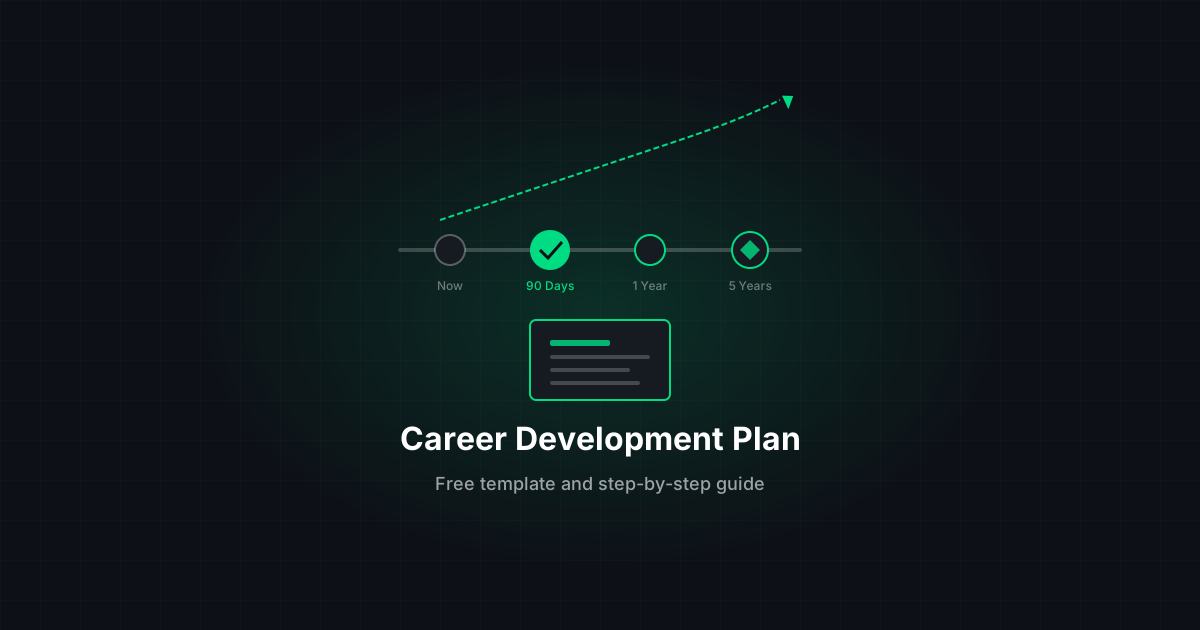
Ready to get more structured? Download our free career development plan template for a comprehensive framework.
This Week
- [ ] Complete one comprehensive career assessment (Holland Code RIASEC is free and validated)
- [ ] List 10 skills with proficiency and enjoyment ratings
- [ ] Rank your top 5 career values
- [ ] Identify 3 industries that interest you
This Month
- [ ] Research 5 specific roles across those industries
- [ ] Conduct 3 informational interviews
- [ ] Take an introductory course in one potential skill area
- [ ] Draft your career hypothesis
This Quarter
- [ ] Test hypothesis through project work, volunteering, or freelancing
- [ ] Build connections in your target field
- [ ] Refine direction based on experience
Moving From Guidance to Action
Career guidance illuminates possibilities. But insight without action changes nothing. The professionals who successfully navigate career transitions share one trait: they take steps while others deliberate.
Your next step doesn't need to be dramatic. It might be:
- Updating your resume to clarify your narrative
- Sending one informational interview request
- Enrolling in one relevant course
- Attending one industry event
Small actions compound into transformed careers. The guidance you need is available. The question is whether you'll use it.
Start with your resume—it forces clarity about who you are professionally and what you're seeking next. Our AI-powered builder provides instant career guidance through the process of articulating your experience and aspirations.
Your career path isn't predetermined. It's built through informed choices and intentional action. Take the first step today.
Related Resources
Build your resume now with our AI-powered resume builder.
هل أنت مستعد لإنشاء سيرتك الذاتية؟
طبّق هذه النصائح مع منشئ السيرة الذاتية المدعوم بالذكاء الاصطناعي.
إنشاء سيرتي الذاتية الآن